
Font Size:
Learn what to watch out for

There have always been parts of metalworking that feel a little bit supernatural to Jim Poor. While most of the craft is the product of diligent training and hard work, some elements of working with heat and metal are stubbornly unpredictable and come down to a touch of each smith’s own personal sorcery.
“In my world of making tools, lastability is the most important thing,” he says. “There’s a lot of heat treating that goes into tooling, and that’s magical stuff because you can’t see it. You do it, but you can’t really know the results until you send it out to the customer. So, it becomes kind of like black magic.”
Jim has been trying to unravel the mysteries of metalworking since he was 12 years old. When he was growing up in Abilene, Texas, his father shod horses on the racetrack circuit, and Jim helped him after school. Once he graduated from high school, Jim found himself shoeing horses after work to make extra cash. It was at 1 of those jobs that he heard about the Texas Professional Farriers Association.
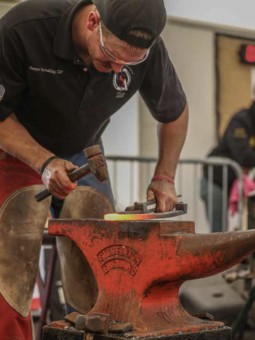
“1 of my customers used to read the local news to me while I was shoeing his horses. And 1 day, he read that this group was going to be at the Abilene County Fair, showing horses for $40,” Jim says. “I was only getting $25, so I thought I should see what these guys were doing.”
Meeting other local farriers and blacksmiths opened up new opportunities to turn his side gig into a full-time job, hone his craft, and even compete across the globe.
“I love competing the most. It’s a small community, but it allowed me to travel all over the world and have so many experiences,” Jim says. “I don’t think anything else I could’ve done with my limited education would allow that.”
Despite his years of experience, Jim remembers having plenty of nerves the first time he competed competitively. It was 1985, 3 years since he started shoeing professionally, when he decided to take part in an event in his hometown.
“I thought it was pretty interesting, but it was scary at the same time,” he says. “There were people there who knew a whole lot more about this craft than I did. I was still pretty young, but I just loved it.”
A few months later, Jim joined some of his TPFA colleagues at a competition in Oklahoma, followed shortly by a trip to the nationals in Jackson, Mississippi. Farrier competition is divided into novice, intermediate, and open divisions, with competitors earning points based on how well they finish and how many others are in their division. Farriers face off in classes where they have a set time to complete a task. Judges rate their performance.
For all his lack of experience, Jim climbed the ranks in short order. After just 3 competitions, he was already shoeing in the open class. Those competitions quickly became highlights of his year, regularly testing himself against hundreds of other farriers as part of major competitions in Texas, California, Florida and Calgary. At one of those events in California, Jim met Kathleen, the woman who would become his wife.
“She can do just about anything, but she does more of the artistic work than I do,” Jim says. “We met each other out there and just became inseparable from that day forward. We dated but could only meet at competitions for several years. Of course, that was another reason to go.”
Over the course of his competitive career, Jim earned a position on the American Farriers Team 9 times, while Kathleen helped establish the first women’s international team, Women Horseshoers of America. After years of traveling the world to compete and teach, they established Flatland Forge in Tuscola, Texas, where they now focus on making farrier tools like tongs, punches, and 27 different styles of hammers.
“Most people are pretty surprised we produce that many different hammers. But I’ve found out that some people are just collectors,” Jim says. “They may not even use them. They just like the look of them and the craft of them.”
In many ways, Jim envies aspiring farriers and blacksmiths today. With the rise of the internet, it is much easier to discover new techniques and learn from the best artisans in the world. Even before the internet, that accessibility was what drew him back to the craft as a young man. But the best advice he can give to anyone forging their path now is the same as it was then.
“What I’ve always loved most is that blacksmithing is something that you don’t need money to learn. All it takes is effort,” Jim says. “You have to be a self-starter. You’ll work 10 times more hours than somebody with a day job. But all you need to succeed in this craft is a willingness to learn and work.”